
How to Search Davis County Court Records
The main public search tool for Davis County District and Justice Court cases is Utah Courts Xchange. Utah Courts describes Xchange as a repository of district and justice court case information. It draws data from CORIS, the courts' case management system, and the courts say records show up as soon as a clerk enters them. Xchange is not fully free. Utah Courts charges one-time, guest, and monthly rates, which the fee table below lays out.
Before you start, gather what you know. A full party name helps, and a case number helps more. You can also narrow by county, court location, and a date range. The official Xchange page explains what the search returns and what stays hidden.
Here is the basic path most searchers follow on the Utah Courts Xchange page:
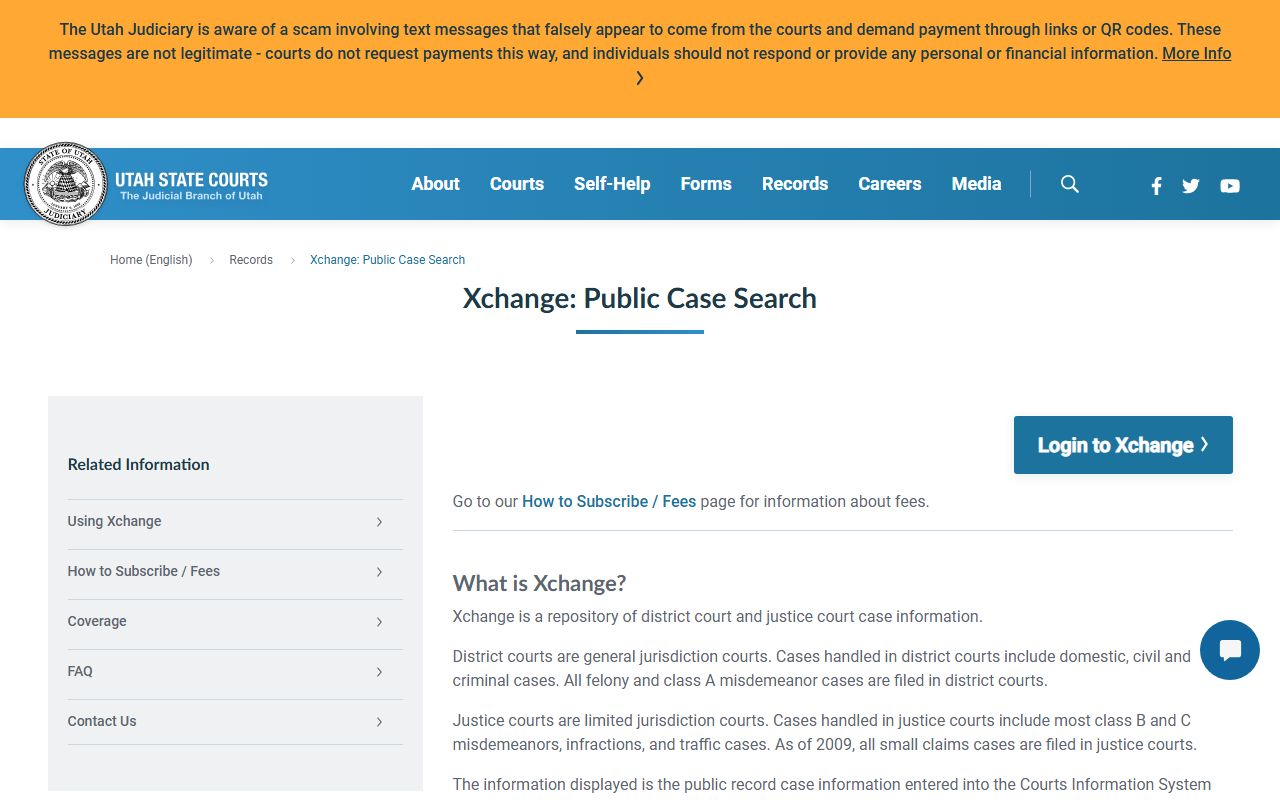
That page links to the login and lists the case types Xchange holds. Use it as your starting point, then move to a paid search or a courthouse terminal if you need full case detail.
- Open the Xchange page and choose a search or subscription option.
- Enter a party name or a case number. For names, add an asterisk, such as John*, because middle names sometimes land in the first-name field.
- Narrow by county, court location, and case type to stay under the result cap.
- Add a filing or disposition date range if a common name returns too many hits.
- Open the case to view parties, judge, filings, hearings, and the outcome. Buy a document image if you need the filed paper.
Look Up and Pay Davis County Cases Online
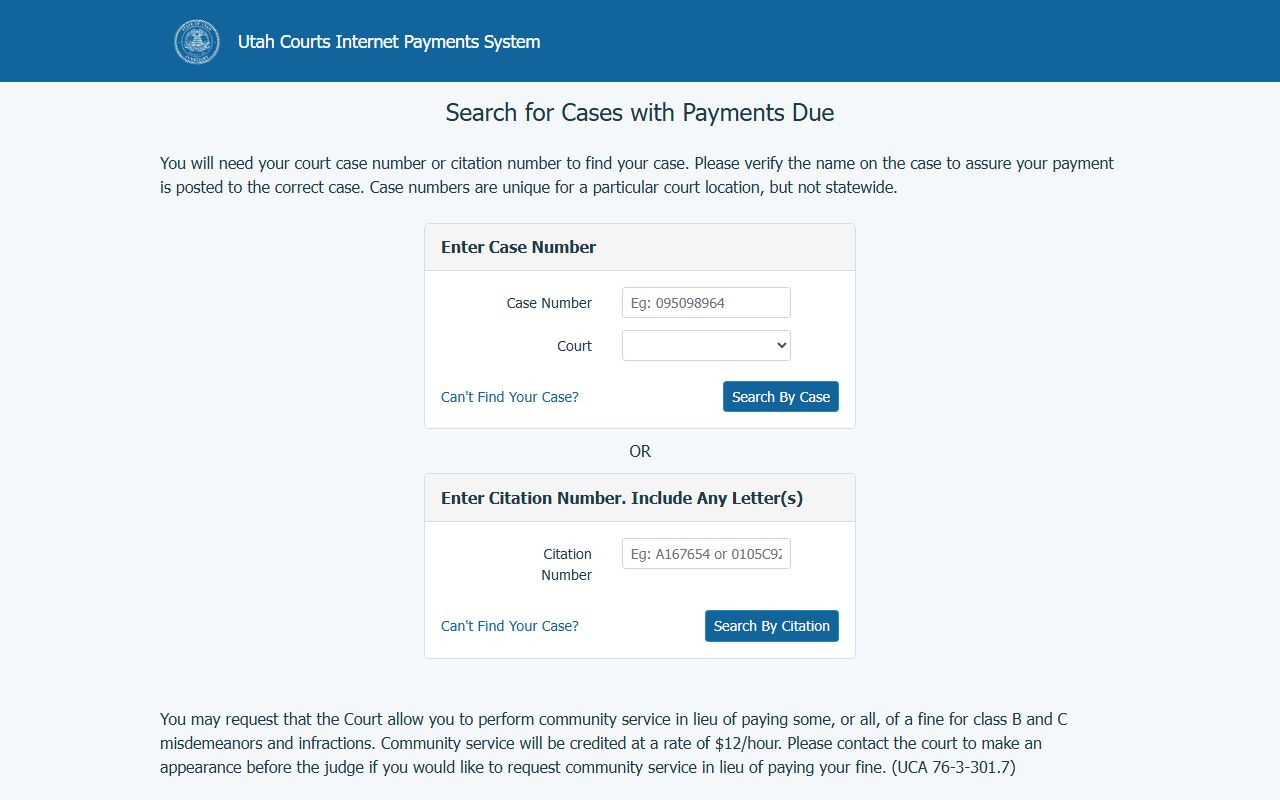
Xchange is the public search product. It is not the only state tool. Utah Courts ePayments lets you find a case or citation to pay a fine, and the search is free even though the payment is not. The catch is simple. You need the court case number or the citation number, and you must pick the right court from a long dropdown.
The Davis-area court choices include Farmington, Bountiful, and Layton District Courts, the Davis County Justice Court, and city justice courts such as Centerville, Clearfield, Clinton, North Salt Lake, Sunset, Syracuse, and Woods Cross. The Utah Courts ePayments search warns that case numbers are unique to one court, not the whole state.
If you are a party to your own case, a third tool may help. MyCase gives a party online access to that party's own district or justice court file. It is not a public search for everyone, so use Xchange for general lookups and MyCase for your own matter.
The Davis County Judicial System
Utah runs a state-administered judiciary. Davis County is grouped with Morgan and Weber Counties in the Second Judicial District. The District Court is the general trial court. It hears civil cases, felonies, class A misdemeanors, divorce and other domestic matters, adoption, probate, and some appeals from agency decisions. The Juvenile Court is not a lower court. Utah Courts says it is equal in status to the District Court, but it handles youth under 18, child welfare, and delinquency.
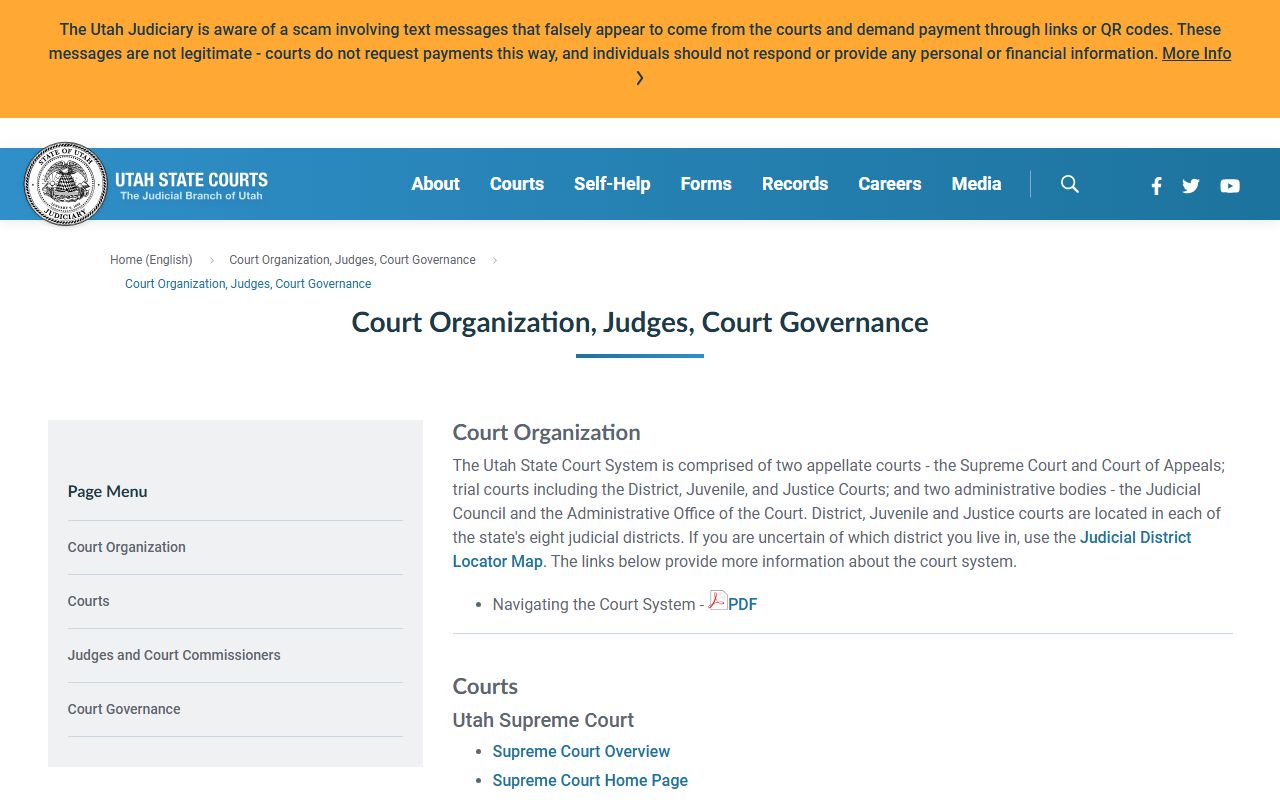
Justice Courts fill the local tier. The county and several cities each run one. They take class B and C misdemeanors, infractions, local ordinance cases, small claims, and many traffic citations. Above the trial courts sit two appeals courts. The official Utah Courts organization page lays out how these levels fit together.
Case flow: Justice Court › District Court › Utah Court of Appeals › Utah Supreme Court
| Court | Jurisdiction | Case Types |
|---|---|---|
| Utah Supreme Court | Court of last resort | First-degree and capital felonies, key civil and constitutional matters |
| Utah Court of Appeals | Intermediate appeals | Domestic, juvenile, and most criminal appeals |
| Second District Court | Davis, Morgan, Weber | Civil, felony, class A, divorce, probate, adoption |
| Second District Juvenile Court | Davis County youth | Delinquency, abuse, neglect, dependency, termination |
| Justice Courts | County and city | Class B/C misdemeanors, infractions, traffic, small claims |
Because of this split, Davis County searchers should name both the case type and the court before they look. A divorce decree is a District Court matter. A county traffic ticket may sit in the Davis County Justice Court, while a city ticket may sit in a municipal justice court. More detail is on the Davis County District Court page.
Davis County Courthouses
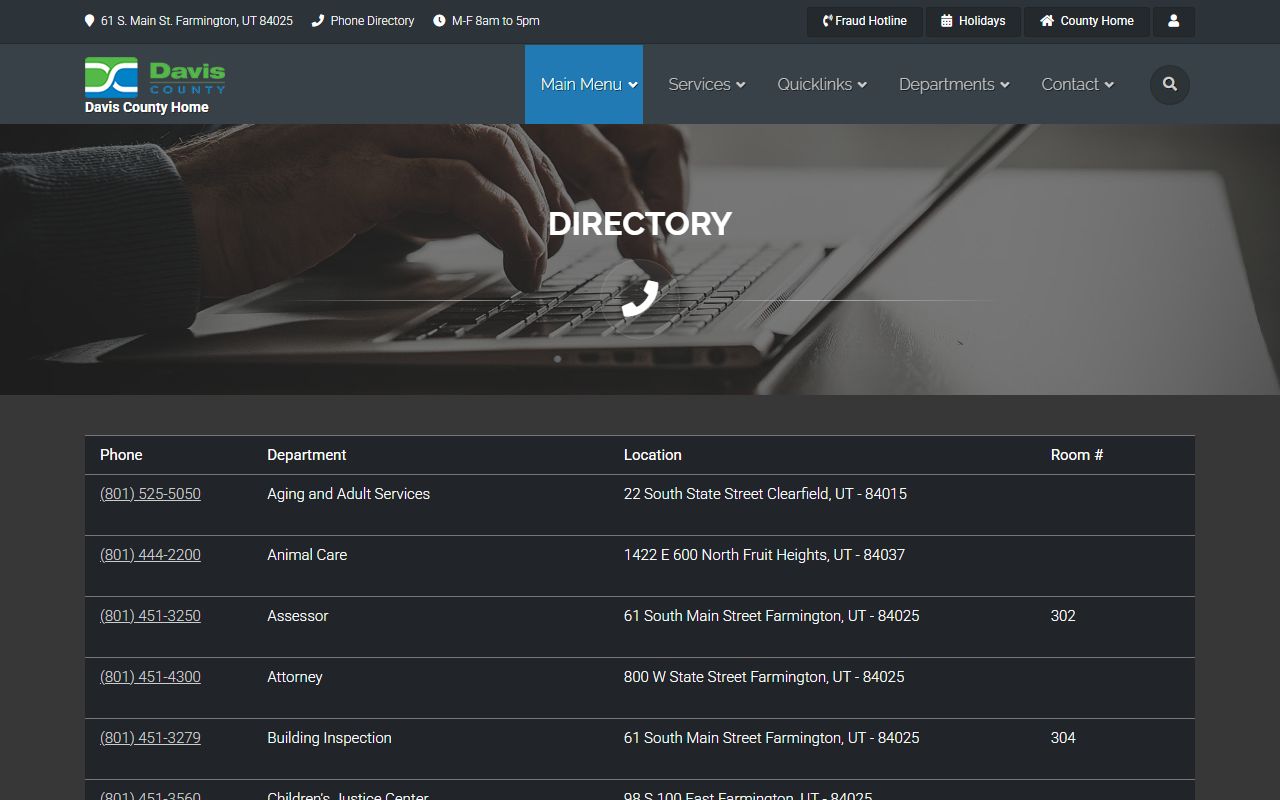
The county's court and law-enforcement campus is concentrated in Farmington. The District Court, Juvenile Court, Justice Court, Sheriff, and jail all cluster around 800 West State Street. District Court cases are also heard in Bountiful and Layton, so the right building depends on where the case is filed. The county directory lists the address and phone for each office.
The Davis County directory is the quickest way to confirm a current phone number or room before a visit.
Types of Court Records Available in Davis County
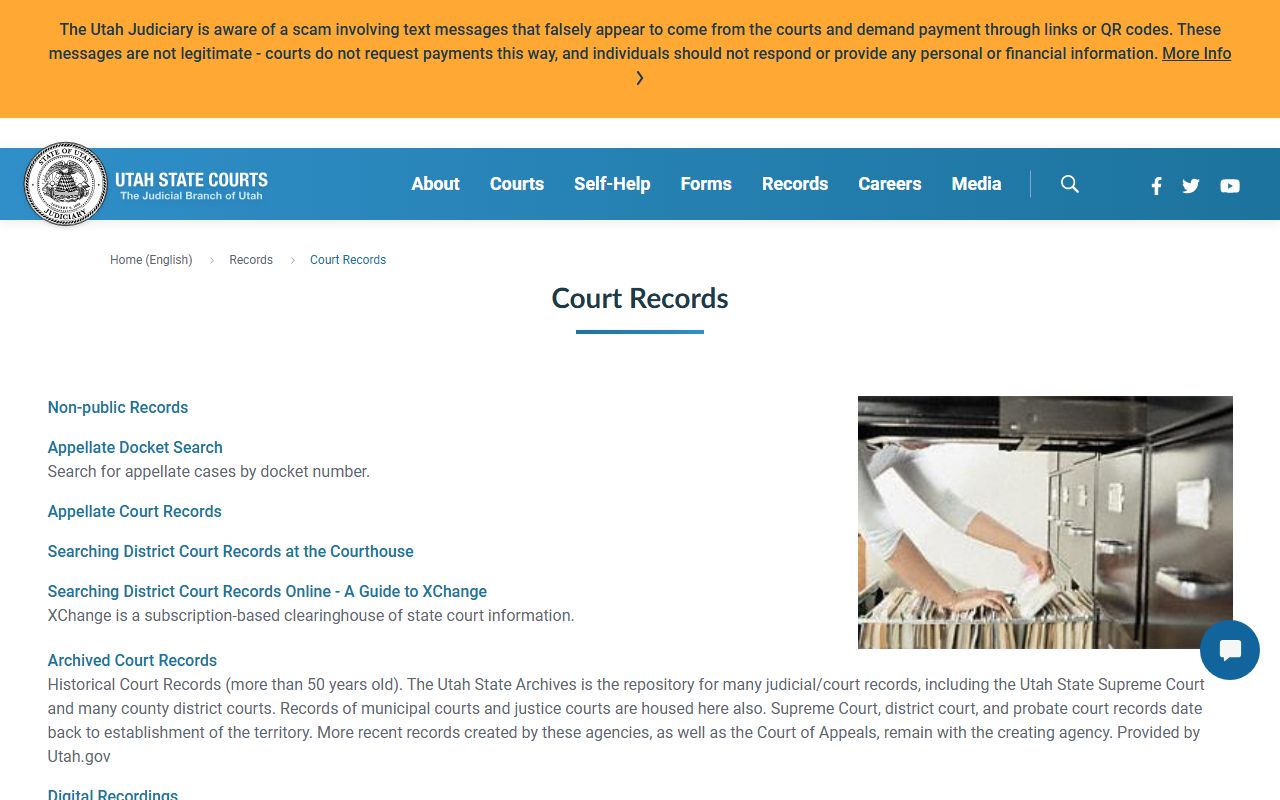
Davis County court records fall into a few broad groups. The District Court produces most civil, felony, family, and probate files. The Justice Courts produce small claims, infraction, and many traffic files. The Juvenile Court holds youth and child welfare cases, and those stay off the public search. The Utah Courts records page gives the broad map of what the branch keeps.
The common record types Davis County searchers ask for are:
- Criminal records - charging papers, pleas, sentencing, and warrants when public.
- Civil records - complaints, answers, motions, orders, judgments, and liens.
- Family and divorce records - many documents are private, but case history and final orders may be public.
- Probate records - wills, estate petitions, and letters of appointment, filed in District Court.
- Traffic records - citations, fines, and dispositions in the Justice Courts.
What Davis County Court Records Show
A Davis County court record is more than a name and a charge. Utah Courts says Xchange shows summary case data, and the fields below appear on most district and justice cases. Party addresses show only when the case is public and the address was given to the court. Document images filed online since July 1, 2010 can be bought from the District Court.
| Field | What It Shows |
|---|---|
| Case Number | The court-specific ID for the file; unique to one court, not the whole state. |
| Filing Date | The date the case opened in the local court computer system. |
| Parties | Names and party type codes, plus an address when the case is public. |
| Charges / Cause | The charge or claim, with the statute or code on criminal and traffic cases. |
| Disposition | The final outcome of a charge or claim, such as guilty, dismissed, or judgment. |
| Sentence / Judgment | The penalty, fine, or money award the court entered. |
The Davis County court records page breaks each field down in more depth and shows a sample search result.
Public Access Laws for Davis County Court Records
Utah splits record access in two. County and agency records, such as sheriff files and clerk files, fall under GRAMA, the state open-records act. Court case files fall under judicial branch rules, mainly the Utah Code of Judicial Administration. A record can be public, private, controlled, protected, sealed, or safeguarded. The default for court files is open, but several categories are closed by rule or order.
A few statutes carry most of the weight for Davis County searchers. Each one below links to the official state text.
Key Statutes:
Utah Code § 63G-2-201 - gives the public the right to inspect public records and get copies during normal hours.
UCJA Rule 4-202.02 - says court records are public unless a rule or order classifies them otherwise.
Utah Code § 53-10-108 - sets limits on how criminal history information is shared.
The Davis County public records page walks through how to file a GRAMA request, what it costs, and how to appeal a denial.
Records That Are Restricted or Confidential
Some Davis County cases never show on the public search. Sealed and expunged cases are pulled from Xchange. Adoption, civil commitment, juvenile delinquency, child welfare, and termination of parental rights cases do not display. In family and guardianship matters, many documents are private, though case history and final orders often stay public unless a judge orders otherwise.
To view a sealed record, a person usually needs a court order. Utah Courts says once a case is expunged, no one can access it without court permission, and the person can state the arrest or conviction never happened. A petition to access or reclassify a court record goes through the procedure in UCJA Rule 4-202.04. The Davis County arrest records page covers expungement in more detail.
Specialty Courts in Davis County
Davis County runs several problem-solving programs through the County Attorney and the courts. Drug Court started in July 1999. It blends intensive treatment, weekly court check-ins, and random testing for non-violent adults who have a prior drug conviction and want help. The county reports retention above 70 percent. Violent offenders and drug dealers are not eligible.
Mental Health Court targets defendants already in the criminal system who live with mental illness. It pairs treatment, medication, and counseling with weekly court appearances and keeps real consequences in place. The county also runs a Drug Diversion program for first-time users and a Plea in Abeyance program for non-violent people with no prior record. The court records for these cases follow the same public-access rules as other criminal files.
Davis County Sheriff and Jail
Sheriff Kelly V. Sparks leads the Davis County Sheriff's Office, sworn in January 2019 after decades with the agency. The Sheriff's Office runs the Davis County Correctional Facility at 800 West State Street in Farmington and posts a public inmate roster that updates every 15 minutes. Booking photos are not shown, because Utah Code § 17-22-30 protects them.
The roster lists booking date, name, gender, age, and a details link with charges and bonds. For the full roster walkthrough, see Davis County inmate records. To check whether someone has an active warrant, use the warrant records page. People recently let go are covered on the released inmates page.
Marriage, Divorce, and Probate Records
Marriage licenses come from the Davis County Clerk, not the courts. Divorce is a District Court matter, and the Davis County Health Department issues Utah divorce certificates for the 1978 to 2010 window. Probate also sits in District Court, since Utah has no separate probate court. See marriage and divorce records and probate records for the full process.
- Testator
- The person who made a will.
- Executor
- The person named in a will to settle the estate, also called a personal representative.
- Conservator
- A person the court names to manage the money or property of someone who cannot.
Marriage and probate files may need a certified copy for legal use. The county and the courts both charge set fees for those copies.
Davis County Court Records Fees
Fees depend on the office and the record. The Davis County Justice Court charges per document and per page for copies. Utah Courts charges for Xchange searches and document images. The Davis County Clerk charges a flat fee for a marriage license. The table pulls the main numbers together.
| Item | Amount |
|---|---|
| Justice Court certified copy | $4.00 per document plus $0.50 per page |
| Justice Court photocopy | $0.25 per page |
| Xchange one-time use | $10 initial, $0.35 per search, $1.00 per document |
| Marriage license (two certified copies) | $60.00 |
Fee waivers may be possible for people who qualify. The Clerk of Court page lists the full copy fee schedule.
How to Interpret Davis County Court Records
Court files use shorthand. A charge is not a conviction. The charge is what the state alleges, and the disposition is the result. A case "dismissed with prejudice" is closed for good, while "dismissed without prejudice" can be refiled. A minute entry is a clerk's short note of what happened at a hearing. A judgment is the final, enforceable decision on money or claims.
Watch the party type codes and the case type codes, since they tell you the role of each name and the kind of case. If a result looks wrong, the court that filed it is the place to fix it. The court dockets page explains how to read the event list on a case.
Accuracy and Record Limitations
Online data moves fast but is not flawless. Xchange shows information as soon as a clerk enters it, yet a recent filing may lag. The Sheriff's roster updates every 15 minutes and is marked informational, not a legal document. For anything that matters, such as a background check or a court filing, get a certified copy from the office that holds the record.
Note: Confirm names, dates, and outcomes with the court or office that created the record before you rely on any online result.
History of Davis County Courts
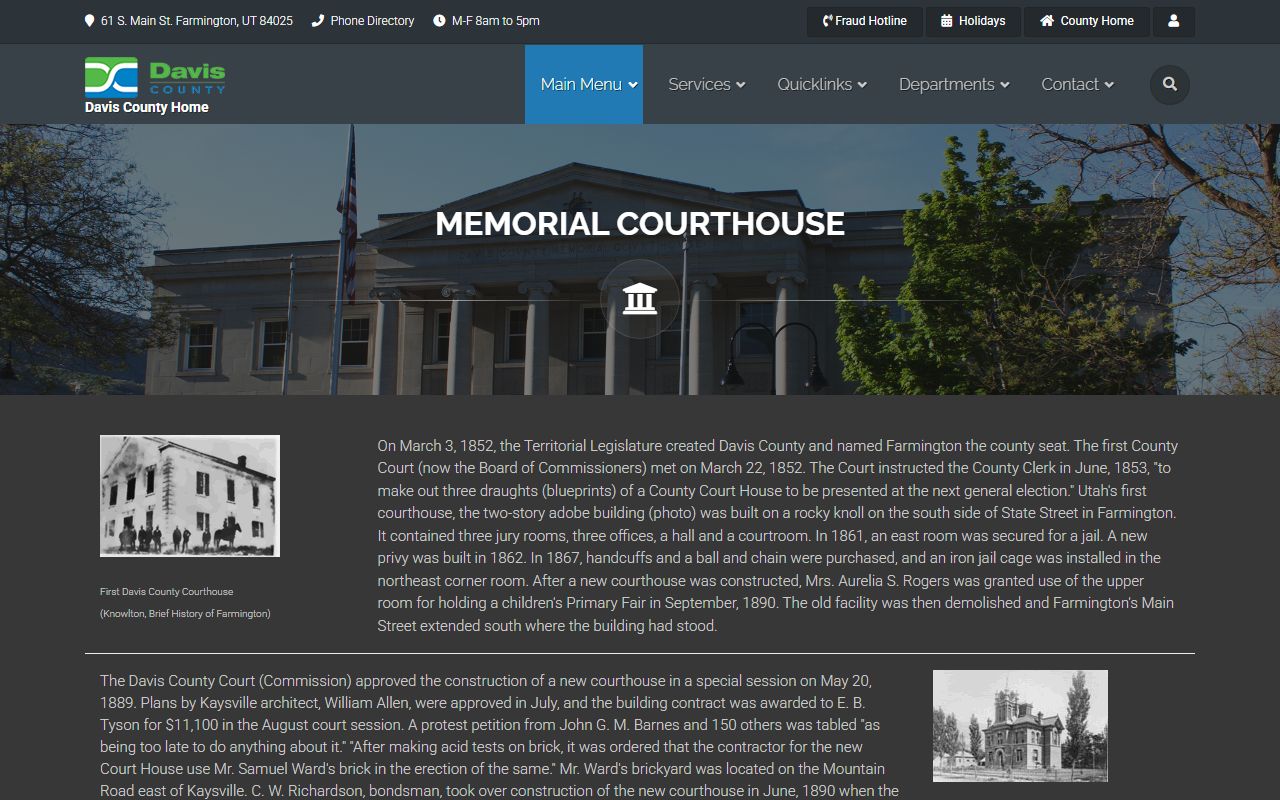
Davis County was organized on October 5, 1850, and named for Captain Daniel C. Davis. Farmington, then called Little Cottonwood, became the county seat in March 1853. The first jail stood on the courthouse grounds and held three cells. The county grew from about 1,598 early residents to an estimated 342,281 today, spread across fifteen communities in a narrow 223-square-mile strip.
The county page on the Memorial Courthouse gives more background on the historic building.
Today the court system is part of Utah's unified state judiciary. Many older Supreme Court, district, and probate records from the territorial era are now held by the Utah State Archives.
Davis County Online Services
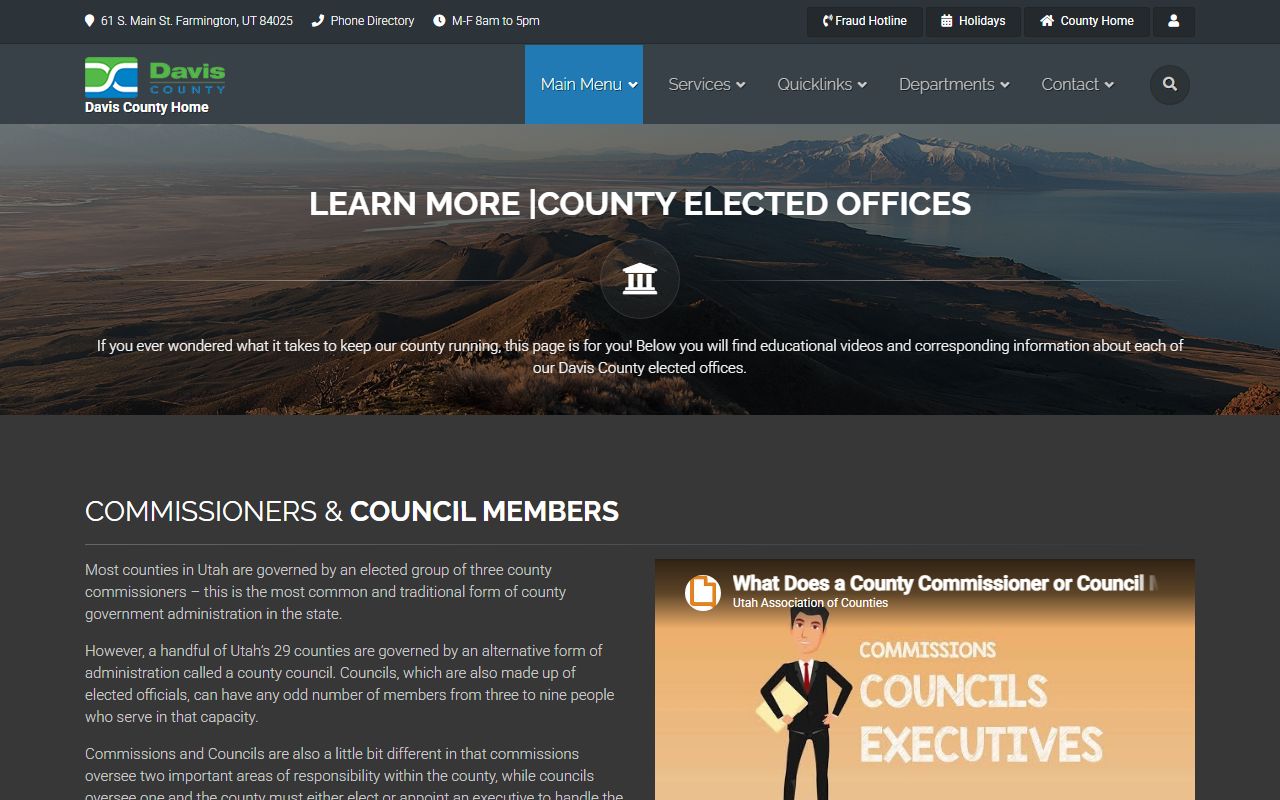
Davis County leans on its own web apps for records. The county runs Property Search, Property Watch, a Sheriff's Dashboard, a GIS map portal, the inmate roster, and online records request links. The county Learn About Us page explains what each elected office does, from the Clerk to the Recorder to the Sheriff.
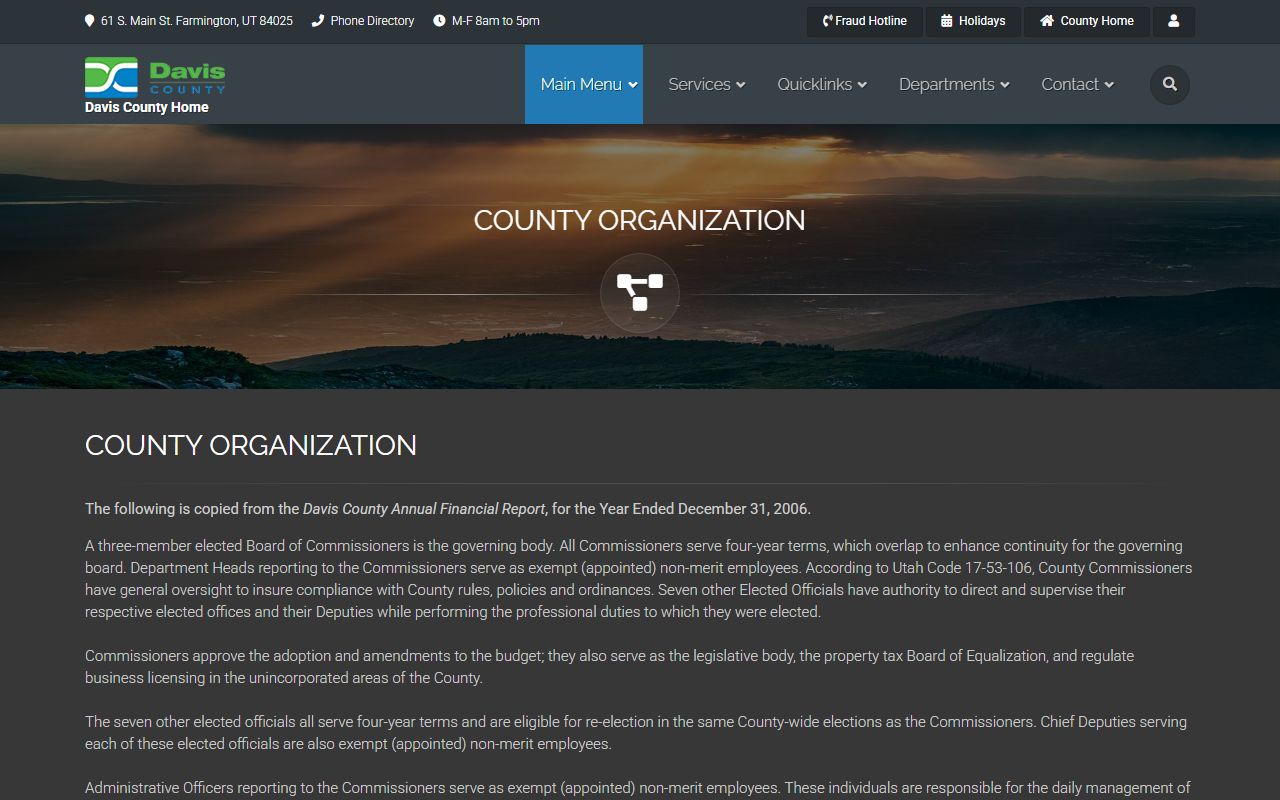
Knowing which office holds a record saves time. The Clerk runs elections and marriage licenses, the Recorder keeps land documents, and the courts keep case files. The county organization page shows how these roles connect.
Frequently Asked Questions
How do I search Davis County court records?
Use Utah Courts Xchange for public district and justice court case data. If you are a party, use MyCase for your own file. To pay a fine, use Utah Courts ePayments with a case or citation number. Courthouse terminals also exist at many district court sites. More steps are on the court records page.
Are Davis County court records free?
Some courthouse terminal access is free, but Xchange is fee-based. Utah Courts charges a $10 initial fee for one-time use, then $0.35 per search and $1.00 per document. A monthly subscription costs $25 to set up plus $40 a month for up to 500 searches.
How do I find an inmate in Davis County?
Use the Davis County Sheriff's inmate roster. It has one name box, a Search button, and a details link for each person. The roster updates every 15 minutes and does not show booking photos. The inmate records page explains each field.
How do I check for a warrant?
Use the Utah BCI Statewide Warrant Search, or call the Davis County Justice Court between 9 a.m. and 3 p.m. on weekdays. BCI can be reached at 801-965-4437 for the court name, case number, and warrant number. See the warrant records page.
More answers are on the Davis County Court Records FAQ page.